
Use AI for the research and the rough work, but write the proof yourself. That is the whole strategy in one sentence.
Hiring managers are not against AI. Nine in ten accept AI-assisted resumes, according to the Hays U.S. 2026 Salary and Hiring Trends Guide. But 86% agree AI creates authenticity challenges and 82% say they are concerned about candidate AI use, per Resume Genius‘ 2026 survey of 1,500 hiring managers.
So the winners are not the people who avoid AI. They are the people who use it where it helps and keep their own voice where it counts. This article shows you exactly where that line is.
What changed about job applications
A few years ago, using AI on your resume was an edge. Now it is the default. Canva’s Global Job Seeker Survey found about 57% of job seekers used AI to create resumes in 2024. By 2026, data firm Clutch put that number at 80%.
When almost everyone uses the same tool the same way, the results converge. One hiring manager’s complaint drew more than 300 comments on Reddit: every resume is written by AI and looks exactly the same, and sifting through copies of the same output is infuriating MarketWatch. Hays calls it a growing “sea of sameness” Hays U.S. 2026 Salary and Hiring Trends Guide.
This is the trap. The tool that was supposed to make you stand out now makes you blend in, because everyone prompts it the same way and accepts the first draft.
Why sameness costs you interviews
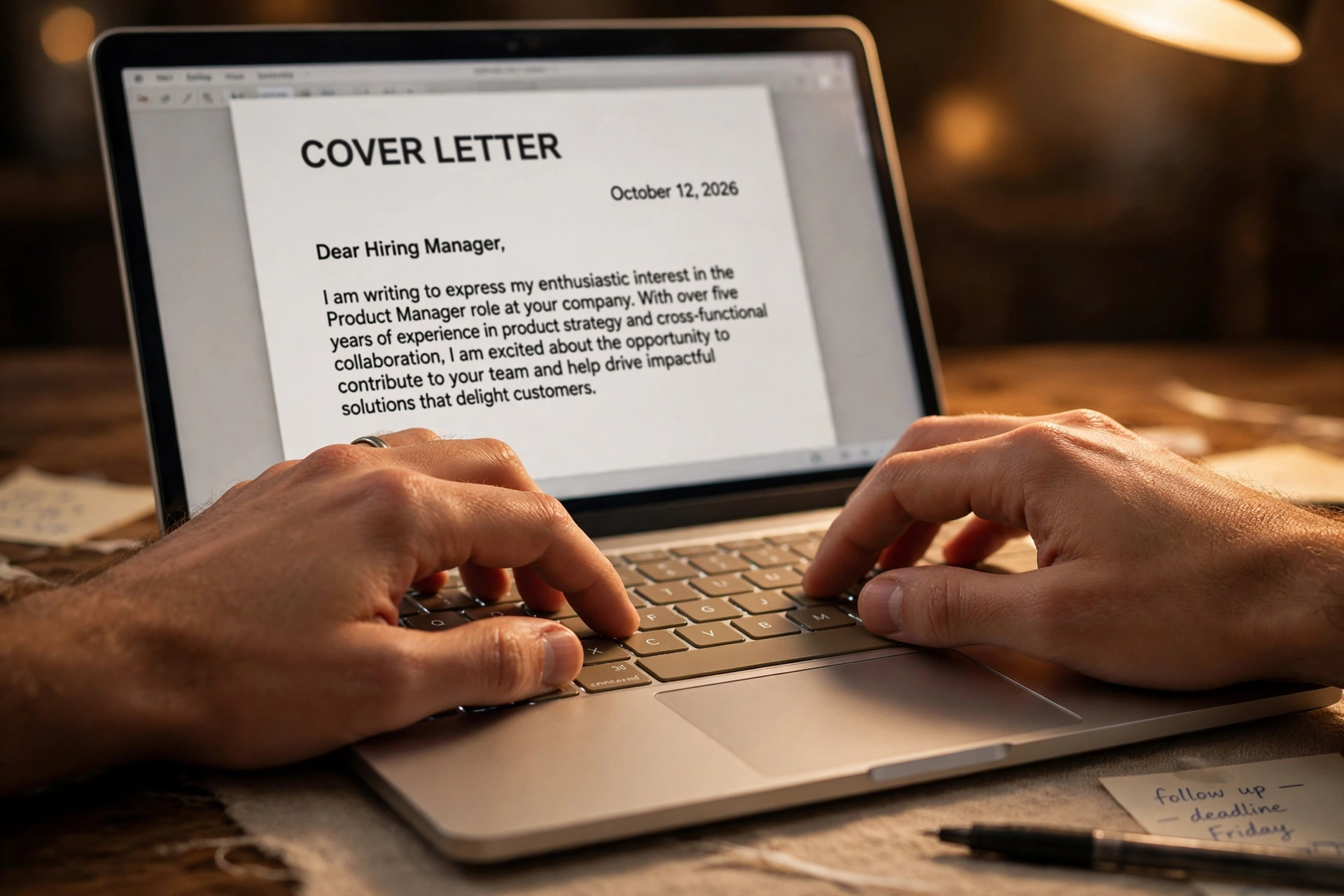
Think about what a hiring manager does with your resume. They skim it for about 30 seconds asking one question: what did this person actually do, and can they do it here?
AI-written resumes fail that skim in a specific way. They are full of confident, generic verbs. “Leveraged synergies.” “Drove impactful outcomes.” “Spearheaded transformative initiatives.” Every bullet sounds impressive and says nothing. After the tenth resume with the same phrases, the reader stops believing any of them.
The numbers back this up. In the Resume Genius survey, 86% of hiring managers agreed AI creates authenticity challenges, and 82% said they are concerned about candidate AI use.
Jim Link, the chief human resources officer at SHRM, put it plainly: “You can generate more volume and more applications by utilizing AI, but volume in the marketplace is not necessarily what gets you hired. Make sure you actually have a story to tell.” MarketWatch
Volume is what AI gives you for free. Story is what you have to supply yourself. Interviews go to the story.
Where AI genuinely helps your search
None of this means you should write everything by hand out of principle. AI is genuinely excellent at parts of the job search. Use it hard in these four places.
Decoding job descriptions. Paste in the posting and ask what the role really requires, what problems the team is trying to solve, and which of your experiences map to them. AI is good at reading between the lines of corporate job posts.
Tailoring without starting over. Give AI your base resume and the posting, and ask it to suggest which bullets to emphasize and which keywords to mirror. You are not inventing experience. You are presenting the right parts of your real experience first.
Interview preparation. Ask for likely questions for the role, practice your answers out loud, and have AI play the interviewer and push back. This is one of the highest-value uses. Most candidates underprepare, and AI makes preparation cheap.
The boring logistics. Tracking applications, drafting follow-up emails, researching salary ranges, preparing questions to ask the interviewer. Let AI handle the admin so your energy goes into the parts that need judgment.
Where you must stay human
Now the other side. There are parts of your application that only you can write, because only you lived them. This is where interviews are won.
Your achievement bullets. AI does not know that you cut customer onboarding from three weeks to four days, or that you kept a key client during a rough quarter, or that you built the spreadsheet the whole team still uses. Those specific, numbered facts are the most persuasive sentences on your resume, and they have to come from your memory.
Your reason for this specific role. “I want to work here because” cannot be generated. If you cannot write two honest sentences about why this company and this team, you have not done the research yet.
The final wording. Read every AI-assisted bullet out loud. If it sounds like something anyone could claim, rewrite it with a number, a name, or a specific situation. “Improved customer satisfaction” becomes “raised the support team’s satisfaction score from 3.8 to 4.6 in six months by rewriting the 20 most-used help articles.”
Here is the rule as a simple table:
| Let AI do this | Do this yourself |
|---|---|
| Analyze the job posting | List your real achievements with numbers |
| Suggest which experience to emphasize | Write why you want this specific role |
| Draft and tighten language | Verify every claim is true and defensible |
| Generate interview practice questions | Tell the stories only you can tell |
| Handle follow-ups and tracking | Make the final call on every word |
A workflow that keeps your voice

Here is a practical sequence you can use for every application.
Step 1: Write your raw material first. Before touching AI, write messy bullets about what you did at each job. Numbers, situations, results. Ugly is fine. This is the part AI cannot do for you, so do it while your memory is fresh.
Step 2: Ask AI to organize, not invent. Give it your raw material and the job posting. Ask it to structure the bullets, tighten the language, and flag gaps where a hiring manager would want a number you have not provided. Tell it explicitly not to invent achievements.
Step 3: Check every claim. Read the draft and delete or fix anything you could not defend in an interview. If a bullet makes you slightly uncomfortable, that is a sign it needs your real detail or needs to go.
Step 4: The read-aloud test. Read the resume out loud. Any sentence that sounds like a template gets rewritten with something specific. Your ear catches sameness faster than your eyes.
Step 5: Tailor per role. For each application, use AI to compare your resume against the posting and suggest keyword and emphasis changes. Keep the facts identical. Change only the framing.
This workflow takes maybe 30 minutes per application instead of 10. Those 20 extra minutes are the difference between blending in and standing out.
What about the AI screening your resume?
There is a twist worth knowing. Some AI screening tools may actually prefer AI-generated resumes, since they are written in patterns the screeners parse easily MarketWatch.
Do not overthink this. Write for the human who makes the final decision, and keep your keywords honest for the machine. A resume with real achievements and the right keywords satisfies both. A generic AI resume might please a parser and bore the human, and the human is the one who invites you in.
The mindset that wins
Stop asking whether to use AI in your job search. Everyone does. Start asking what job you give it.
Give AI the jobs it does well: research, organization, tightening, practice, logistics. Keep the jobs only you can do: the achievements, the numbers, the reasons, the stories, the final judgment on every word.
The candidates who stand out in 2026 are not the ones with the most polished AI output. They are the ones whose applications contain proof that a machine could never have written, because it never lived their career.
Frequently Asked Questions
Will recruiters reject me if they can tell I used AI?
Probably not for the use itself. Nine in ten hiring managers accept AI-assisted resumes, per Hays. What hurts you is overreliance: a resume so generic that the reader cannot tell what you did. Use AI as an assistant and the question never comes up.
Should I list AI skills on my resume?
Yes, but as applied outcomes, not as a tools list. “Used AI to automate weekly reporting, saving six hours a month” beats “Proficient in ChatGPT.” Hiring managers respond to proof.
How do I tailor my resume without lying?
Mirror the posting’s language around your real experience. If they say “stakeholder management” and you “kept clients updated,” use their phrase for your true activity. Tailoring is translation, not invention. Never add experience you do not have. It collapses in the interview.
Is it cheating to use AI on applications?
No, it is not cheating. With 80% of job seekers using it, using AI has become the normal way applications get written now. Cheating is inventing jobs, degrees, or results. Using AI to organize and polish your true history is just good communication.
What is the single change with the biggest payoff?
Put numbers in your bullets. Every vague achievement becomes convincing with a number attached: revenue, time saved, people served, percentages moved. Numbers are the fastest way to sound like yourself, because they are yours.
Want to build the AI skills employers actually reward, in plain English and at your pace? Book a call and we will design a learning plan around your real work.
Need a second pair of eyes on your search?
Our mentorship program pairs you with someone who has been through it, from positioning your AI skills to prepping for the interviews that matter.
If you want the practical tools behind this workflow, download the AI Job Application Pack, which includes resume bullet formulas with before and after examples, a cover letter framework, interview prep prompts, and a fillable job search tracker.